
Introduction
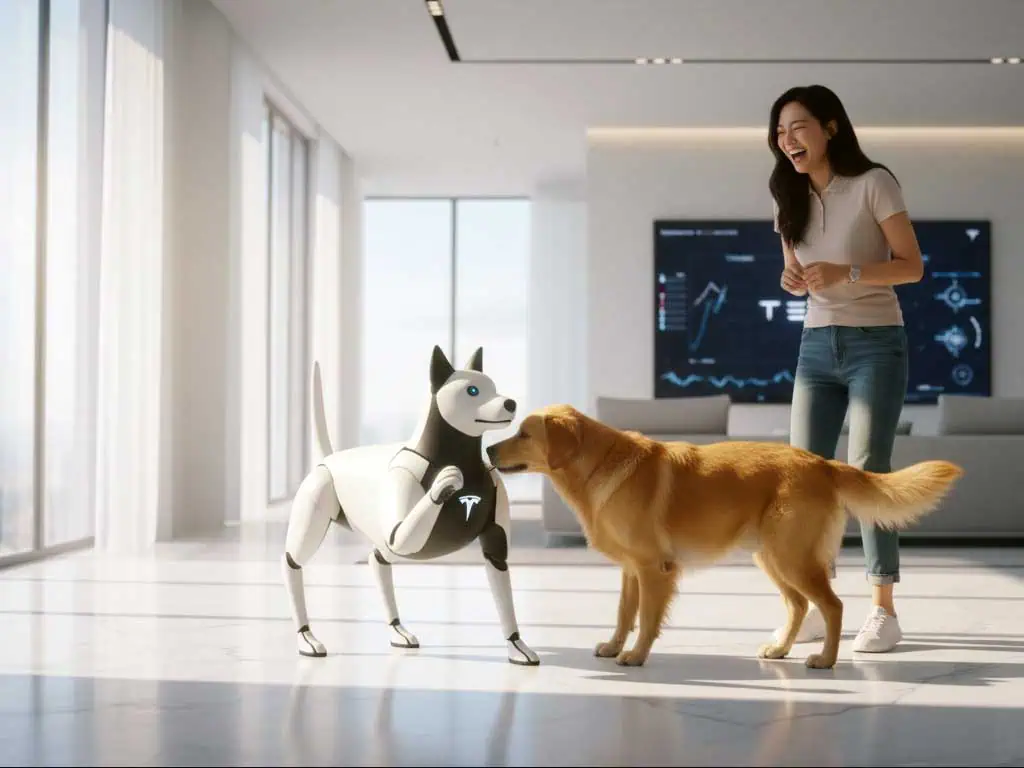
Tesla Robot Dog is a concept that redefines what we think a “pet” could be in the era of artificial intelligence. Imagine a four-legged robotic companion built with Tesla’s advanced vision systems, AI chips, and machine-learning capabilities — capable of walking beside you, responding to your commands, and even acting as a household assistant. While Tesla has yet to officially announce a robot dog, the company’s track record in robotics and automation makes this idea more realistic than ever. This article explores the origins, design possibilities, potential features, safety considerations, and the emotional impact of this futuristic smart companion.
Table of Contents
Why Tesla Could Build a Robot Dog
Tesla’s evolution from electric vehicles to AI-driven robotics makes this idea entirely plausible. The company has already unveiled the Tesla Optimus, a humanoid robot introduced during Tesla AI Day. This project showcased the company’s expertise in artificial intelligence, neural networks, and actuator design. A quadruped robot dog would be a logical next step — taking what Tesla learned from the humanoid form and applying it to a more stable, agile platform.
Unlike a bipedal robot that must balance upright like a human, a four-legged robot has a natural advantage in mobility and stability. It can navigate homes, climb small steps, and maintain balance even if bumped or walking on uneven surfaces. By leveraging Tesla’s computer vision systems — the same ones used for Autopilot and Full Self-Driving (FSD) — the Tesla Robot Dog could recognize objects, people, and pets around the house without needing complex lidar systems. Tesla’s philosophy of “vision first” machine learning would fit perfectly into a robotic dog’s design.
From a production standpoint, Tesla already operates at massive scale. With factories across several continents, Tesla could theoretically mass-produce a robotic pet at a lower cost than existing quadruped robots like Boston Dynamics’ Spot. The combination of manufacturing capacity, hardware efficiency, and Tesla’s software ecosystem makes this concept not only visionary but commercially feasible.
Potential Features of the Tesla Robot Dog
The Tesla Robot Dog would represent more than just a novelty gadget — it could redefine home assistance and companionship. Based on Tesla’s existing technologies, here are features that are both likely and visionary.
Vision-based navigation
Tesla’s advanced neural vision systems could allow the robot dog to “see” and understand its surroundings. Instead of relying on lidar sensors, it could use multiple cameras — similar to Tesla cars — to recognize objects, avoid obstacles, and even identify its owner by facial recognition. The robot could follow you around the home, track your pets, or deliver small items with precision.
Agile and adaptive movement
With four articulated legs powered by Tesla’s proprietary actuators, the robot dog would move fluidly and quietly. It could navigate through living rooms, hallways, and outdoor patios, adjusting to different terrains like rugs, grass, or tiles. Its gait could even mimic the natural movements of a real dog, creating a more lifelike experience.
Home integration through Tesla ecosystem
Imagine commanding your Tesla Robot Dog from your phone or Tesla app. Integration with Tesla’s smart-home systems could allow the robot to detect when you’re approaching home and meet you at the door, patrol the house while you’re away, or sync with your Tesla vehicle for home-to-car communication. This level of integration would make it a central part of Tesla’s connected ecosystem.
Security and surveillance mode
One of the most intriguing use cases from concept videos and community speculation is a security or “patrol” mode. Equipped with motion sensors and night-vision cameras, the robot could move quietly through your home while streaming live footage to your phone.
Payload and utility compartment
Tesla’s engineers are known for maximizing utility. The robot dog might include a small compartment or tray for carrying objects such as mail, medicine, or snacks. In future iterations, it could use a small robotic arm or magnetic grip to pick up light items.
Voice and gesture interaction
One of Tesla’s most promising AI directions is imitation learning — robots learning from human behavior. The robot dog could respond to voice commands and gestures, recognize emotions from tone and facial expression, and even learn routines through observation. Over time, it could adapt to its owner’s habits, making it feel less like a machine and more like a personal assistant with personality.
Possible Specifications and Pricing
Because this is still conceptual, official specs are unknown. However, based on Tesla’s hardware capabilities, we can estimate the potential design.
The form factor would likely match a medium-sized dog, such as a border collie — compact enough for home use but large enough to carry sensors and a battery pack. The sensor suite could include wide-angle cameras, ultrasonic sensors, and IMUs (inertial measurement units) to help maintain balance and detect nearby motion.
For battery life, a typical session could last 1 to 3 hours of active movement before automatically returning to a dock to recharge. Tesla’s battery optimization experience from EVs would be invaluable here.
As for price, early predictions across tech communities suggest anywhere between $2,000 to $8,000 depending on materials and features. While that may sound steep, it would still be far more affordable than Boston Dynamics’ Spot, which costs tens of thousands. If Tesla scaled production, the price could fall closer to high-end smartphones or laptops — putting advanced robotics within reach of average consumers.
Use Cases: Everyday Benefits of a Robotic Companion
The Tesla Robot Dog could transform everyday life through real, useful tasks rather than novelty tricks.
As a home companion and monitor, it could follow you around, respond to greetings, and recognize when family members enter or leave the house. It could act as a playful companion for children or a silent observer that keeps an eye on elderly residents.
As a fetching assistant, it might retrieve small objects from one room to another, such as bringing your phone or medication from the counter. Its dexterity and onboard AI could make it precise enough to carry delicate items safely.
For home security, imagine leaving for work and saying, “Guard mode.” The Tesla Robot Dog would activate patrol mode, quietly moving through the house while scanning for motion, recording footage, and sending real-time alerts if something looks wrong.
For mobility or health support, it could assist elderly users or people with disabilities, acting as a mobile communication device, emergency alert system, or even a steady companion that provides psychological comfort.
Safety, Privacy, and Responsibility
While the Tesla Robot Dog could bring extraordinary convenience, it also raises important safety and privacy questions. A home robot with cameras and microphones must be transparent about data collection. Owners should be able to disable streaming, store recordings locally, and know exactly what data is shared with Tesla’s servers.
Physical safety is equally important. The robot must be designed to move around pets, children, and furniture without causing harm. Rounded edges, soft padding, and precise motion controls would make it safe to interact with humans and animals alike.
Tesla would also need to comply with electrical and mechanical safety standards for consumer products. If the robot were to assist the elderly or children, additional certification would be required for medical or caregiving devices.
Beyond engineering, Tesla must consider the psychological aspect: how people form attachments to machines. A lifelike robot dog could evoke strong emotions, so Tesla would need to communicate clearly that it’s a robotic companion, not a living pet replacement.
Tesla Robot Dog vs Existing Quadruped Robots
To understand what Tesla might achieve, it helps to compare the concept with existing robots. The Boston Dynamics Spot is currently the most well-known quadruped, used in construction, research, and inspection tasks. It’s incredibly agile but also expensive and industrial-focused.
The Tesla Robot Dog, by contrast, would target consumers. Its key advantage would be Tesla’s vertical integration — producing sensors, chips, batteries, and AI in-house. This could dramatically reduce costs and allow software updates just like Tesla’s cars.
If Tesla succeeds, it could make the first affordable, emotionally engaging quadruped robot designed for the mass market.
The Emotional and Social Side of a Robot Dog
Beyond the hardware, the emotional side of robotics is what makes this idea truly fascinating. Many people live in apartments where pets aren’t allowed or have allergies that prevent them from owning animals. A robot dog could provide a sense of companionship without the maintenance or restrictions of a real pet.
Imagine waking up to a machine that greets you with subtle gestures, recognizes your morning routine, and walks with you around the house. It doesn’t shed, bark excessively, or require feeding — yet it still provides the feeling of being accompanied. For some, that emotional connection could be profound, especially for those living alone.
It also ties into the growing world of smart home and tracking technology. Devices like those featured in our Complete Guide to Pet Tracking & Home Monitoring already show how tech enhances how we care for pets. A future Tesla Robot Dog could be part of this connected system — blending companionship, automation, and monitoring into one intelligent household companion.
However, the emotional bond between humans and machines raises ethical questions. Could people develop unhealthy attachments? Should a robot simulate emotions it doesn’t truly feel? These discussions will shape the next decade of consumer robotics — and Tesla is in a position to lead that conversation.
What to Watch for Next
If Tesla decides to pursue a robot dog seriously, here are key signals to look for:
- Mentions or teasers in future Tesla AI Day presentations.
- Patent filings related to quadruped locomotion or home-assistance robots.
- Collaborations between Tesla and AI or robotics startups.
- Small pilot programs or limited releases for Tesla owners.
- Integration announcements linking the Tesla app with home robotics features.
Helpful Links and Further Reading
External authority:
Tesla — AI & Robotics — official Tesla page showcasing the Optimus robot and Tesla’s AI capabilities.
FAQ Tesla Robot Dog
Is the Tesla Robot Dog an official Tesla product?
Not yet. Tesla hasn’t confirmed any robot dog, but the concept builds on its existing Optimus humanoid robot and AI systems. Elon Musk has hinted at expanding robotics into new forms, and many believe a quadruped companion is a logical next step. For now, it remains an advanced concept inspired by Tesla’s growing robotics expertise.
When will the Tesla Robot Dog be released?
There’s no official timeline, but experts speculate that prototypes could appear around 2026–2027 once Optimus development matures. Tesla may first use it internally for factory tasks before releasing a home version. Any consumer launch would likely follow years of safety testing and production scaling.
How much will the Tesla Robot Dog cost?
If Tesla releases it, analysts expect pricing to range between $2,000 and $8,000 depending on its technology and hardware. This would make it far more affordable than Boston Dynamics’ industrial robots, and Tesla’s large-scale manufacturing could lower the cost over time.
Can the Tesla Robot Dog connect to other Tesla products?
Yes — that’s one of the most exciting possibilities. It could sync with Tesla cars, the Tesla app, or home energy systems to act as a mobile smart assistant. For example, it might patrol your home while you’re away, or alert you through your Tesla app about unusual activity detected inside.
Will the Tesla Robot Dog replace real pets?
No. The robot dog would complement, not replace, real animals. It’s designed for companionship, security, and assistance — especially for people who can’t own live pets due to allergies or housing restrictions. It can offer emotional comfort and smart-home functionality, but it won’t reproduce the full emotional bond of a living pet.
Is it safe to have a Tesla Robot Dog at home?
Safety would be a top priority. Tesla would likely include obstacle detection, soft-contact design, and data encryption for privacy. The robot would move gently around pets and people, with automatic shut-off or “safe mode” features to prevent collisions or overheating during operation.
Can the Tesla Robot Dog work with home cameras or pet devices?
Yes, that’s very possible. It could integrate with smart home tools such as the Furbo 360° Dog Camera — Review & Features or similar devices for seamless monitoring. This would create a connected ecosystem where users can track pets, monitor rooms, and automate home security together.
Watch a Relevant Video
To visualize the concept, you can explore a popular YouTube video titled “Tesla DOG Robot Finally HERE! Elon Musk Reveals New Factory Guard!” — watch it here:
Caption:
This video demonstrates concept art and early footage inspired by Tesla’s robotics division and Elon Musk’s hints at future automation projects. While it’s not an official Tesla release, it helps illustrate how the Tesla Robot Dog might look and behave. Treat it as an artistic or speculative interpretation, not a confirmed product demonstration.